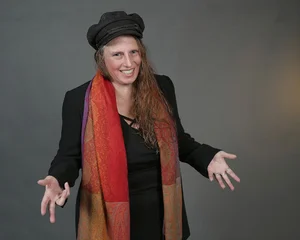
Reclaiming the Real with Gretchen Andrew
[00:00:00]
Aicila: Hello. Today I'm chatting with Gretchen Andrew. Gretchen's Art flips the invisible edits of AI beauty filters into bold oil portraits using custom robotics. She translates the seamless face tune tweaks that shape our social media selves into full body paintings of pageant queens from 100 countries.
Her series face tuned portraits. Universal Beauty exposes how a single al algorithm, how a single algorithm erases diversity, turning every brushstroke into a visual record of the clash between authentic appearance and the AI ideal. Through her work, Gretchen reveals the hidden scars of digital perfection and invites us to rethink what it means to be truly beautiful.
Welcome to the show, Gretchen.
Gretchen: Great. Thank you so much for having me.
Aicila: Now this is a topic I think we could actually talk about a lot. And I love that, the hidden scars of digital perfection. What is something that you wish more people knew about this topic or art or the, the digital imperfections?[00:01:00]
Gretchen: Many of the images that we're seeing on social media are not real people. They do not exist, and while beauty standards have always caused pressure. Before have we and our young people been seeing so many images of faces and bodies that make a literally impossible beauty standard?
Aicila: Yeah, no, it's really true. There's like, there's this, and I think the, the part of it that I, I find upsetting and intriguing at the same time is how subconscious it is. It is not like I sit there and I look at social media and and have some kind of conscious thought of, oh, this is what things should look like, and then go look in the mirror and think, that's not me.
It's very much a subconscious impact. Mm-hmm.
Gretchen: especially in Western culture. These apps, these filters are very common. They exist on Zoom [00:02:00] through a feature called Touch Up My Appearance. They're built into cell phone cameras because every digital camera has an algorithm in it.
Aicila: Wow.
Gretchen: it's, there's a, a spectrum of this. It's not just teenage girls on TikTok, it's men on their LinkedIn profile.
It is, um, people in Zoom meetings that when you meet them in person, you don't really recognize them because they've been using some sort of filter. And what has also happened in this very insidious process is we've become so used to seeing people on screens,
Aicila: Mm-hmm. Yeah.
Gretchen: and these beauty standards have evolved to reflect how we look on a screen more than in real life. I'll give you an example.
Aicila: gonna say, can you break that down a little bit? 'cause I don't know that I understand completely.
Gretchen: So one of the things that a lot of these apps and filters do to women is they make really big lips.
And these lips are so big. And [00:03:00] so, because within two dimensions, it's trying to create the third dimension within the flat screen.
Aicila: Mm-hmm.
Gretchen: from the front, some people think that looks great with the big lips, but from the side.
Also known as duck lips. It's less popular. It's, it's an unintended consequence of wanting very big lips from the frontal view, but it's because we have physical bodies that exist in physical space. We have to keep knowing that there is a third dimensionality to this, but because people prioritize being seen as visually attractive on the flat screen.
They're willing to sacrifice the third dimension, the side view for the way
that they look in that frontal view.
Aicila: Hmm. They maybe don't even think about it.
Gretchen: No, I think that there's- all I know is that this is increasing in popularity. It's the same homogenized beauty standard that is occurring across culture. [00:04:00] It used to be that different countries, different traditions would produce different beauty standards. But now with social media, the internet, YouTubers, and even video podcasts like this, especially in the manosphere, there's a lot of jaw surgery going on that's
Aicila: Hmm.
Gretchen: very similar to what happens with women in the lips. These images, these ideas of beauty and of manliness are perpetuating throughout the world in a single way. Causing people to actually go into plastic surgeons, to injectable clinics and modify their physical bodies to reflect these filtered
changes that we've grown used to.
Aicila: Wow. We are so, we are so susceptible to that as, as people. I, so one of the things that you talked about is the, the understanding, sort of this challenge of AI is shaping these unrealistic beauty standards, and it sounds like there's another step where people are actually trying to make these unrealistic [00:05:00] beauty standards, uh, happen.
It and I, you also are an artist, you know, and I, I feel like artists sometimes are seen as, as having their own unrealistic, you know, beauty standards. So how does that all fit together? Like, you know, taking the, it sounds to me almost like instead of trying to paint the ideal, you're, you're trying to paint the real.
Gretchen: Yeah, I, I
think that the, bringing in the tradition of beauty and art is very poignant here. And it's one of the reasons why I do operate in the tradition of portraiture within the tradition of painting where people like really pleasant images.
Aicila: Mm-hmm.
Gretchen: I'm doing instead is taking the face in the body and essentially making that same filtering process, which is usually invisible.
Aicila: Right.
Gretchen: I make it messy and physical so that instead of moving pixels around to make a skinnier or give a straighter teeth or bigger eyes, those become marks and scars as the algorithm through a [00:06:00] robot actually tries to implement that filter in physical space.
Aicila: Interesting. So you're like, I've got your, your PDF up, I'm wondering if I should show one and you can explain it for the people that are listening on the audio, I apologize. You won't know what we're
Gretchen: I actually have one behind me. If do, why don't I
Aicila: don't we do that? Yeah, because I, I think it'd be kind of neat to kind of give some sense of like, what's happening here.
So scoot over a little bit. Yeah, right. I can't, yeah, there we go. All right. So as the, so do you paint that or does the robot take the, the filter and like put that on there?
Gretchen: So what's happening here
is I have a special printer that can reproduce photographs in oil paint.
So it's a lot like when, have you ever had a photograph printed on a birthday cake?
Aicila: Mm. I've seen that done. Yeah.
Gretchen: Yeah, so it's the, it's the same sort of thing, like it's an edible because it's on top of the scene, but it's just a photo on top of the frost scene.[00:07:00]
That same thing happens with the photograph in oil paint, but then while that painting is still wet, while that photograph reproduced in paint is still wet, I give it to a robot that applies the beauty filter, but because it's applying the, the algorithmic changes because it's applying the filter into wet paint as it cuts away my cheek because it's apparently too fat or my boobs because they're apparently not big enough. It makes a mark, it makes a scar.
and so everywhere we see these brush strokes on top of the photograph is because the way that I look is not up to the AI standard of beauty.
Aicila: Right. Got it. Kind of chilling 'cause it looks, you look a little mangled there.
Gretchen: Yes. Well, that's part of what I really want to do with this is say that we are mangling ourselves. We're mangling our expectations of ourselves and of each other. And it's happening invisibly and without us talking about
it.
Aicila: [00:08:00] Yeah. How would you, how would you talk to somebody? 'cause they're, I feel like the, the biggest pushback that I will hear about. Movements like this that try to sort of, there's a few, but the, that I'm thinking of in this moment is feel like, well, you shouldn't care what people think about how you look, or you shouldn't care about beauty.
Like, how would you respond to something like that?
Gretchen: This is another great question for an artist who I'm I, I always say that this isn't. This conversation here is not about shame. It's not about if you do this or want to do this to feel shame around it. I believe that our appearance should always reflect our love of self. and if you are getting a haircut or braces or an injectable or plastic surgery that comes from a place of love of self, then it's going to be very different.
I just think that so much of this is driven by insecurity and a desire to be accepted by our peers
as much as by the algorithm.
Aicila: Hmm. [00:09:00] Yeah, well, it, it does cause real harm. I used to do, um, nonprofit training around inclusion and I did some reading about, I think when Fiji first had American television, they went from like zero, um, eating disorders in like one, and then like one or two years they had tons and tons of kids with eating disorders just from watching our television.
And this is an even more accessible and insidious form of unreachable standard.
Gretchen: Because we're seeing not just ourselves be transformed by these algorithms. We're seeing our peers be transformed by them. And it's not just celebrities where we do have a little bit more of distance between how
Aicila: Yeah.
Gretchen: they're, they're possibly beautiful. Like that's as much as we might want to close that gap, we're more comfortable with there being a gap
Aicila: Yeah, exactly. I mean, you just like, you wanna admire them on a screen that's, you know, they're gonna be in a big [00:10:00] screen. You understand that I'm not gonna be in big screen. I can have some flaws. Like
Gretchen: Yes,
exactly. Like, uh,
Aicila: nobody. Nobody staring at that.
Gretchen: my pores would look like the Grand Canyon on a big screen, but now it's actually the small screen
even for celebrities, even for television. And we watch celebrities and we follow celebrities and we follow our parents and we follow our friends and they get presented within the same.
Context to us that we might be watching an Oscar nominated film, but we might be doing it on our tablet, in which we're also looking at our cousin's
wedding.
Aicila: Got. Yeah. And so that's, that context can, can override some of our common sense maybe about what is and isn't fair or realistic. In terms of our own expectations of, of how we're gonna show up or be seen. That
Gretchen: And the British Psychology Society
did publish a paper where. They documented that the harm of using these apps on ourselves is worse than when we see them used on other [00:11:00] people.
Aicila: Oh really?
Gretchen: Watching watch, watching our bodies go through these transformations is more harmful to our mental health than other people. And you know, so I've, I've done, we just looked at one, uh, I've been working, and we'll get into this later, I'm sure the Miss Universe contestants, but I've done this whole process on myself. I don't use these apps normally, my Instagram doesn't have me in a modified way, but for the purposes of art and research, I did use these apps on myself.
And what I found is that I started with an image that I thought I looked great in, and then I put it through the filter and I saw the new image and I, I didn't like it, but then I went back to the original image to myself in the mirror, and I liked it less.
There was something disruptive. I, oh, like, I guess I don't look skinny in that photo, or I, I guess my arms could be a [00:12:00] little bit more toned.
I started to notice flaws that I had not
had any awareness of before.
Aicila: Hmm. Interesting. Wow. Well, and I mean, there's a whole other rabbit hole that you can get into, but you know, they talk about zoom fatigue, and I was, I was reading about that. And some of it is like the part of you that, like, when you're looking at yourself, even I, you know, I don't look at myself now, look at myself.
I always hide myself when I can, but that can actually exhaust you because it, it activates this like part of your brain that engages. And, and usually needs time to rest. And so that's where that even on a screen, you're constantly interacting even if you don't realize you are.
Gretchen: I zoom fatigue. That's such a a, a great term. I'm going to have to. Do some more research on that because even when things are not heavily filtered, there's a reason why when the new [00:13:00] iPhone comes out, we all talk about, oh, the camera's so good. We've like had seven or eight iPhones now where you can take photos that can blow up to billboard size.
What's improving is not the quality, but the algorithmic choices that that camera is making, mostly in relationship to our faces and bodies.
Aicila: Hmm.
Gretchen: And we're almost on this cycle of, oh, those photos look better. I need the new iPhone
now as well. And there's this whole very dark connection into consumerism and to capitalism where. Tina Fey in her book Bossy Pants. It came out, I mean, more than only a decade ago or more. She talks about how when she grew up she was like, I wasn't pretty. And when I grew up, that just meant you developed a personality.
Aicila: remember that was so funny.
Gretchen: but then she says, but today, if you're not pretty, you're supposed to fix it.
You're supposed to go get injectables. You're supposed to go on [00:14:00] ozempic. You're supposed to get your hair, and you know, whatever people are doing to their hair now. And I like to ask men how much they think lip injections cost. And the average estimate I'm getting is about $75, where depending on where you live, we're talking four or $500 for this treatment.
That is very common. And so. There's also this, you know, opportunity cost of this money that women and men increasingly are spending on, on making themselves live up to this ideal. And that just also has a literal cost to it.
Aicila: Yeah, it does. Talk about the miss Universe pageant, uh, pictures that you did.
Gretchen: So some of the paintings that I've done in this space Tune series are of beauty queens from Miss Universe. And so these women are so gorgeous. [00:15:00] They're from all over the world. And yet when you give them to these algorithms, to these filters, they too are not good enough.
Aicila: Hmm.
Gretchen: The algorithm will always find something that it wants to change about you.
Aicila: Hmm.
Gretchen: And in starting with such famously beautiful women, we can see the absurdity of that. Like, okay, if they're not good enough, like we have no hope,
Aicila: Right.
Gretchen: and they're from all over the world, Ms. Jamaica should not have the same body as Ms. Finland, who should not have the same body as Ms. Japan. But that is what these algorithms do is they say, everyone must have this conglomeration of, you know, legs from one tradition, eyes from this tradition, lips from another tradition, and it's not solely a western or white beauty standard that these apps are promoting.
It is a somewhat unnatural conglomeration of body parts that is impossible for almost everybody as
a result.[00:16:00]
Aicila: Yeah. What would, what does success look like for you?
Gretchen: I have defined my role as an artist as a bit actually in thinking about the inclusion space, is that I think an artist is someone who's celebrated for being themselves,
and I've defined my career as being paid and celebrated for being myself. And so being paid, rewarded and celebrated for being you. This is something that is maybe more natural to an artist's definition, but I believe it's something that in any career, in any job, we also have a right to,
Aicila: Yeah.
Gretchen: of, of workplace culture doesn't
really allow people to do that.
Aicila: N No, it's true. Well, we're whole people like I feel like there's that. There when people talk about it not being personal or, or having professional boundaries, like there are ways in which that's true. Like [00:17:00] if I, if I need someone to come in and fix my sink and someone comes up in and they're an electrician and I don't hire them, it's not personal.
I just don't need that service like that. That's, that's what people mean when they mean, like it's not personal. And then, but then also like professionally, if I have just gone through something, my partner has cancer, or I've experienced a loss that's with me at work. I don't have to talk about it, but that is still part of my experience. And there needs to be a space for understanding that it doesn't disappear when you walk through the door.
You're still eng engage. You know, whether and whether you give people time off or whether they choose to take it off. They're still all the way there. And that has to be also acknowledged. You know, we're not, we're not robots. We can't cut pieces. I don't wanna cut pieces myself off with a filter or emotionally, let's be clear.
Gretchen: Yeah. Have you, have you watched severance?
Aicila: Oh yes. Excellent point. Excellent point.
Gretchen: Yeah. Yeah. I mean, one of the reasons why I struggled, and granted, I think if I were to go back to the corporate world, which I won't [00:18:00] do. But if I were to, I would have better boundaries. But I also knew when I was 22 and working in tech that I wanted to have a life's work and not a work life balance. And I think especially in tech now as we're seeing in 2008.
It was significantly more prestigious. There's a lot more valid skepticism towards the industry. The industry is laying people off and cutting salaries for the first time
in a major way. And I had a professor who, his advice to me was that by the time I'm 40 to figure out what I love to do and figure out how to get paid for it. And these sort of dual goals where I have a lot of friends who spent, I'm approaching 40, and I have a lot of spent friends who spent their time between university and now learning how to get paid, but not figuring out what they love. And I think at any age you can start either of those processes. I mean, I definitely did it in the other order where I figured out what I [00:19:00] loved and then figured out how to get paid for it. But that, those two things I think are very important too, if not, keep in balance. Keep in a a dual goal because if you do great work, you should be rewarded for it. And I don't think we have to separate our passions from our ability to live the life that we want. And so that does make it very hard to be in a job or a workplace where you can't bring your full self.
Aicila: Yeah, I'm, I'm very committed to that. I just think that a lot of us would be, we have so much to offer that doesn't, doesn't get tapped into because we're in situations or jobs that have a very limited scope. And that if we could step into a place where we could do what we love. I mean they, I don't believe this whole, like, do what you love and you'll never work a day in your life.
Like there's tedium, there is tedium in everything. And I, I feel so much satisfaction in what I do. And I feel so much joy that I get to do it. That even when I'm sitting here going, gosh, this is tedious. There's this part of me that is [00:20:00] also a little delighted that I have the opportunity to do this tedious thing that's part of this other thing that I really love. And I, I feel like that's, that's such a gift. And it is a privilege, but I wish it weren't. I want everybody to have access to that.
Gretchen: There's a notebook I have downstairs that my best friend got me. And it, it says like exactly, we said the do what you love and you'll never work a day in your life. But then it crossed out. It has it crossed out. You'll never work a day in your life and written and it says like you'll work yourself like crazy. You'll take everything personally. And like you, like it was. It's sort of like the actual experience of that. But it is, it is so different when your value and your reputation is independent of the place that you work. You could go work for a corporation. I could go work for a corporation today. And our
sort of transferable capital in and out of that establishment would be a lot higher because we have a reputation that can't be taken away [00:21:00] by our job
being taken away.
Aicila: Right. And a kind of independence almost that I think is valuable.
Gretchen: I think they, like 15 years ago, were calling it a personal brand, but it's really just transferable knowledge and reputation. Right.
Aicila: Yeah. Every few years there's a new name for it, I guess.
Gretchen: yes.
Aicila: What advice would you give your 18-year-old self?
Gretchen: I would tell my
18 year self, 18-year-old self that you're going to make it
and what you're doing is valuable.
I think the hardest thing is when just had some of my artwork acquired by the Whitney, which is a life goal,
Aicila: Wow. Congratulations.
Gretchen: thank you and. Even on this journey I had reflected, but especially after this occurred recently, I, I started thinking what would I have done differently if I had known I was going to reach this point and at 37?
Aicila: Right.
Gretchen: And the biggest difference would've been that I would've [00:22:00] enjoyed the journey so much more. It's stressful when we don't believe we're, when we're not sure if we're going to make it. If we know that we're going to get that project, or if we know that we're going to get that house eventually, or we know if we're going to find that partner eventually.
It just, the whole thing becomes self-development and fun. And I think like you, we probably love self-development. I love learning about myself. So those trials and those setbacks can be seen as part of a whole story. And I'm, I'm trying to
think about how that applies to me going forward.
Aicila: Yeah. No, that's, I think that's a good, it's a really good advice at any age to enjoy the journey. I, um, so I have adult children. I had children really young. You know, I, and I, I really wanted to be a mom, honestly. And I remembered when I was like 12 years old, my cousin was having her second baby. And my grandmother was asking her, what would you do differently?
And she said, well, I would enjoy, like, [00:23:00] all of the phases, like the midnight feedings. She goes, I, I, I really, I got, I wanted him to get through it so I could sleep. And she realized that I missed those things. Like they were special times. She was also exhausted, like for, you know, anyone out there who was like, yeah, you're, no, I know, but for whatever reason, probably 'cause I was eavesdropping and you get all the best information on you're eavesdropping.
I remembered that. And so when I had my kids, I, I did really focus on enjoying each phase, even when they sucked. There was this thing of like, I might miss this. Like I might miss them, you know, waking me up in the middle of the night and, and wanting to be comforted. And do I miss it specifically? No, but yeah, there was a sweetness to that relationship, that is, that it's in the past, it's in my memories and I got to have that. And I feel like that made the whole, all the things that were hard, differently, um, flavored, if you will. So, I can relate to that. It was a, it is a good, it's a good way to go if you can like get in that mindset. I don't know how to do it anywhere else. Like I was really good at doing it in parenting, but [00:24:00] then in other places I'll be like, I don't like this. But so, I mean, I'm not trying to pretend I'm evolved or anything, but
Gretchen: Right. Like, I mean, these are aspirational goals,
but even everything I'm, I'm saying they're, they're both what I do and what I hope to do.
But there's, I, I read a biography of Rockefeller, I think two summers ago, and one of the things that really stuck with me. And it is how much he loved work and how much he loved to golf, and how much he loved time with his family.
So he was never rushing from one thing to the other because he was never trying to get to the good part. Because for him it was all the good part.
And I think about that so often, whereas my long to-do list of everything I have to do today. I actually, in isolation, I like any one of these things. It's feeling like I have to do all of the things.
And whereas if, if it was just one thing, do I [00:25:00] actually really like, you know, um, going, I, I love going, working out for me, like I love it, but do I sometimes feel like I'm squeezing it in and rushing through it? Yeah, instead of like, okay, Gretchen, just remember you like this. This is the good part.
It's all the good
Aicila: part. It's all the good part. I like that. That's really great. Um, do you have any, uh, like let's say somebody wants to. I don't know, engage in more understanding around this impact. Are there any tips you can give people around how to get a perception of how the filters are affecting them or, if there's a way people can bring this knowledge into their day-to-day action in some fashion?
Gretchen: I mean, I would encourage people who have not personally used one of these filters to do an isolated experiment where you do see the way that it transforms you. Because that will help you understand the way in which it's transforming other people that you see.
Aicila: Yeah.
Gretchen: I would assume that most people are slightly filtered on social [00:26:00] media, if not extremely filtered on social media. But going, actually, you don't even have to do this for yourself.
Take an image from the internet. And filter it and just see the changes. Look at the before and after and analyze what's happening here. And then keep that difference in mind as you're looking at media.
Aicila: Yeah. That's good advice. Is there anything you're excited about, things coming up that people can, you know, or you have any classes or shows or events?
Gretchen: I am really excited about the, I'm evolving this series to look at more men.
Aicila: Oh, cool.
Gretchen: this is not a teenage girl on TikTok problem. This is something that impacts everyone. And I recently read an article about how plastic surgeries are up 50% in the last couple years in Silicon Valley amongst Tech Bros, because there's such a cult of youth.
And there are quotes like Peter Thiel will say, don't fund anybody over 30. [00:27:00] And it's, this is not the gender equality I wanted. I wanted us to drop this as women instead of for men to be incorporated into this insecurity. The focus of how you look versus what you do. I think men have had a more privileged opportunity to do that than women, and it seems like men are now.
Unfortunately losing that as well.
And so I am looking at the male body, the male expectation, the connection between how men look and how they're supposed to look and what that pressure is doing to to that set as well.
Aicila: Wow. Yeah, that's, this is not the gender equality I wanted either. I like that. And then for folks that are listening, how do they learn more? Follow you, get in touch.
Gretchen: Yeah, absolutely. I'd love to hear what you have
to think about all this. I am on Instagram at Gretchen Andrew, also gretchen andrew.com. On my website, you'll find an email newsletter you can sign up for. So if you [00:28:00] are in any of the cities or places where I'm holding art events, we'd love to have you. We try and throw some of the most joyful events in the art world and very intent on hearing more about this perspective outside of the art world.
Aicila: Thank you. Thank you so much for joining me today. I appreciate it.
Gretchen: Thank you for having me.
Thank you for tuning into business as unusual, remember, in this ever evolving world of modern business, it's not about fitting in.
It's about standing out. See you next time. Stay curious, stay innovative, and always keep it unusual.